
Buy the book: Print | Ebook | Daraz
Or, browse more book summaries
The Book in Three Sentences
- Financial success is not determined only by income, education or investment knowledge; it is largely determined by behaviour.
- Building wealth requires saving, patience and long-term compounding, while preserving wealth requires humility, caution and the ability to survive difficult periods.
- The most valuable benefit of money is not displaying an expensive lifestyle but gaining freedom and control over your time.
Book summary
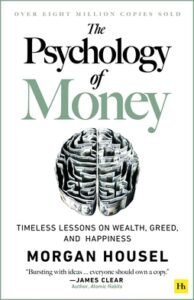
The Psychology of Money: Timeless Lessons on Wealth, Greed, and Happiness is a personal-finance book written by Morgan Housel. It explains that financial success depends less on intelligence and more on how people behave with money.
Instead of presenting complicated investment formulas, Housel uses short stories to examine saving, spending, wealth, greed, risk, luck and financial freedom. The publisher describes the book as a collection of 19 short stories that explore how people think about money. Harriman House
1. No One Is Crazy
People make financial decisions based on their personal experiences. Someone who grew up during a recession may be extremely cautious about investing. Another person who experienced a rising stock market may be more comfortable taking risks.
These individuals may receive the same financial information but interpret it differently. Their decisions are influenced by what they have personally experienced.
Housel therefore warns readers against quickly judging another person’s financial choices. A decision that appears unreasonable from one perspective may appear completely sensible from another.
The lesson is that financial advice cannot always be applied equally to everyone. Your financial plan should reflect your goals, responsibilities, income, risk tolerance and life circumstances.
2. Luck and Risk
Success and failure are influenced by both individual effort and circumstances beyond an individual’s control.
Hard work, knowledge and discipline matter, but luck can also affect financial outcomes. Similarly, a person may make a reasonable decision and still experience a poor result because of an unexpected event.
Housel uses this relationship between luck and risk to encourage humility. Successful people should not assume that every achievement resulted entirely from their intelligence. People who experience failure should not automatically believe that they lack ability.
The practical lesson is to study broad patterns instead of copying one exceptionally successful person. Individual stories may contain unusual levels of luck or risk that cannot be repeated.
This lesson connects closely with the ideas examined in Fooled by Randomness by Nassim Nicholas Taleb.
3. Never Enough
The desire for more money can become dangerous when a person has no definition of “enough.”
People naturally compare themselves with others. Someone earning a comfortable income may still feel unsuccessful after comparing themselves with a wealthier colleague, neighbour or celebrity.
This comparison can create a never-ending cycle. When income increases, expectations and lifestyle expenses also increase. Satisfaction remains out of reach because the target keeps moving.
According to Housel, knowing when you have enough is an important financial skill. It does not mean abandoning ambition. It means recognising the difference between healthy progress and risking something valuable for something unnecessary.
Reputation, relationships, freedom and financial security should not be placed at risk merely to acquire more money or status.
4. Confounding Compounding
Compounding occurs when an investment earns returns and those returns begin generating additional returns. Its greatest results normally appear over long periods.
People often focus on achieving the highest possible annual return. Housel suggests that earning reasonable returns consistently for several decades can be more powerful than earning exceptional returns for only a short period.
Warren Buffett’s investment success is used to illustrate this principle. His ability is important, but the extraordinary duration of his investing career allowed compounding to produce enormous results.
The lesson is not that everyone should copy Buffett’s investments. The lesson is to appreciate the importance of time.
Good investing is not necessarily about becoming wealthy quickly. It is about developing a sustainable strategy and giving it sufficient time to work.
5. Getting Wealthy Versus Staying Wealthy
Building wealth and preserving wealth require different abilities.
Building wealth sometimes requires optimism, confidence and a willingness to accept reasonable risks. Preserving wealth requires humility, saving, caution and preparation for unexpected events.
A person may make money through one successful investment or business opportunity. However, maintaining that wealth for decades requires avoiding decisions that could cause permanent financial destruction.
Housel describes survival as a critical financial strategy. Investors must remain financially secure enough to endure recessions, market declines, unemployment and personal emergencies.
Long-term compounding only works when a person can remain invested. Therefore, financial survival should be valued more than the pursuit of maximum returns.
6. Tails, You Win
In investing, business and creative work, a small number of successful outcomes can generate most of the overall results.
An investor may own many average or unsuccessful investments, while only a few outstanding investments produce the majority of the portfolio’s returns. Similarly, a company may test numerous products before discovering the one that becomes highly profitable.
This means failure is not always evidence that an entire strategy is wrong. A person can be incorrect frequently and still succeed if a few correct decisions produce exceptional results.
The lesson is to avoid judging a long-term process by every individual result. What matters is the combined outcome over time.
7. Freedom
One of the strongest messages in The Psychology of Money is that control over time is a valuable form of wealth.
Money can allow a person to decide when to work, where to live, what opportunities to accept and how to respond to emergencies. This flexibility may create greater happiness than expensive possessions.
Financial freedom does not necessarily mean never working again. It means having sufficient resources and flexibility to make decisions without being controlled entirely by immediate financial pressure.
Saving money therefore purchases more than future goods. It purchases independence, options and time.
8. The Man in the Car Paradox
People often purchase expensive possessions because they want admiration from others. However, when someone sees an expensive car, they normally admire the car rather than deeply admiring its owner.
The owner may believe the vehicle communicates wealth and success. The observer, however, may simply imagine how impressive they would look driving it.
Housel uses this paradox to show that material possessions do not always create the respect people expect. Respect is more often earned through character, kindness, humility and achievement.
Expensive purchases are not automatically wrong, but people should understand the real reason behind them.
9. Wealth Is What You Don’t See
Richness and wealth are not exactly the same.
Richness is often visible through a high income, expensive car, large house or luxurious lifestyle. Wealth is usually invisible because it consists of assets that have not been spent.
A person may appear rich while carrying substantial debt and having very little savings. Another person may live modestly while possessing investments, savings and financial security.
Real wealth is the ability to purchase something but choose not to. It is the money preserved for future opportunities, emergencies and independence.
This is why judging someone’s financial condition from their lifestyle can be misleading.
10. Save Money
Housel argues that saving should not depend entirely on having a specific future purchase in mind.
Saving without an immediate purpose creates flexibility. Life is uncertain, and people cannot predict every future expense, opportunity or emergency.
A person’s savings rate can also matter more than investment returns, particularly during the early stages of building wealth. Investment performance may be outside an individual’s control, but spending and saving habits are more manageable.
Saving is partly the difference between income and ego. When people feel less pressure to prove their success through possessions, they can retain more of what they earn.
The importance of assigning money intentionally also appears in Profit First by Mike Michalowicz.
11. Reasonable Is Better Than Rational
The mathematically perfect financial decision is not always the best practical decision.
A completely rational strategy may recommend accepting high levels of volatility to maximise long-term returns. However, if that volatility causes an investor to panic and sell during a market decline, the strategy will fail in practice.
A reasonable financial plan considers human emotions. It should be a plan that a person can follow during both favourable and difficult conditions.
It is better to use a slightly imperfect strategy consistently than to abandon a theoretically perfect strategy under pressure.
12. Surprise
Financial history provides useful lessons, but it cannot predict every future event.
The most significant economic events are often surprising precisely because they have no clear precedent. Wars, technological breakthroughs, financial crises and social changes can transform markets in ways that earlier data did not anticipate.
Investors should study history to understand human behaviour, fear, greed and risk. However, they should not assume that the future will follow the past exactly.
The lesson is to expect uncertainty and build a financial plan that can survive unexpected events.
13. Room for Error
Room for error means creating a financial safety margin between what you expect to happen and what you can survive if your expectation is wrong.
Examples include maintaining emergency savings, avoiding excessive debt, using conservative financial assumptions and not investing money required for essential short-term expenses.
A safety margin may appear unnecessarily cautious during good times. Its value becomes visible when circumstances change.
Housel does not suggest avoiding every risk. Instead, he recommends taking risks that will not destroy your ability to continue if the outcome is unfavourable.
14. You’ll Change
People find it difficult to predict how their future priorities will change.
The career, lifestyle or financial goal that seems perfect at age 25 may no longer be suitable at age 40. Extreme long-term plans can therefore become restrictive.
Housel recommends maintaining balance and flexibility. Avoiding extreme saving or extreme spending makes it easier to adjust when circumstances, responsibilities and personal goals change.
A good financial plan should allow your future self to make new decisions.
15. Nothing Is Free
Every valuable financial return has a price. In investing, that price frequently appears as uncertainty, fear and temporary losses.
Investors often want high returns without experiencing market volatility. However, volatility should not always be seen as a fine imposed for making a mistake. It can be understood as the cost of participating in markets that offer long-term growth.
People who are unwilling to accept any uncertainty may choose safer investments, but they should also accept the possibility of lower returns.
Understanding the price of an investment makes it easier to remain patient when difficult periods occur.
16. You and Me
Different investors play different financial games.
A short-term trader, a long-term retirement investor and a professional fund manager may respond differently to the same market information. Each has a different time horizon, objective and tolerance for risk.
Problems arise when people copy financial decisions made by someone playing a different game. A long-term investor may purchase an overpriced asset after observing short-term traders earning quick profits.
Before following financial advice, identify the adviser’s objectives and time horizon. Your decisions should match your own financial game.
17. The Seduction of Pessimism
Pessimistic predictions often sound more convincing than optimistic ones.
Financial declines can occur quickly and attract immediate attention. Progress normally develops slowly, making it easier to overlook.
A market crash can happen within days, while economic growth, technological improvement and business expansion may develop across decades. Negative news therefore appears urgent, while positive long-term progress may seem ordinary.
Housel does not recommend ignoring risks. He recommends maintaining a balanced perspective: prepare for short-term difficulties while recognising the potential for long-term progress.
18. When You’ll Believe Anything
People want explanations for an uncertain world. When an outcome is important but difficult to predict, they may accept stories that make the future appear understandable.
This behaviour is common in investing. Market forecasts can sound persuasive even when they are based on incomplete information.
The greater a person’s desire for a particular outcome, the easier it becomes to believe a story supporting it. Investors should therefore separate attractive narratives from reliable evidence.
Humility is essential because markets, economies and human behaviour cannot be predicted with complete certainty.
19. All Together Now
In this chapter, Housel combines the book’s central principles into practical financial guidance.
He recommends saving regularly, defining what “enough” means, avoiding decisions that could cause permanent financial ruin and allowing investments sufficient time to compound.
He also encourages readers to respect uncertainty, remain humble about success and construct financial plans they can maintain emotionally.
There is no single financial strategy suitable for everyone. The best plan is one that supports your personal goals and allows you to sleep peacefully.
20. Confessions
In the final chapter, Housel explains how his family manages money.
He recognises that personal financial decisions do not need to be mathematically perfect. His priorities include independence, low debt, savings and control over time.
This chapter demonstrates that understanding financial theory and making personal financial decisions are not identical. People must choose a plan that reflects their values, responsibilities and comfort with risk.
The purpose of money is not merely to produce the highest numerical return. It should help create a secure and meaningful life.
Major Lessons From The Psychology of Money
The most important lessons from the book are:
- Financial behaviour matters more than financial intelligence.
- Personal experiences influence how people think about money.
- Luck and risk both affect success and failure.
- Defining “enough” protects people from uncontrolled greed.
- Compounding needs time more than extraordinary returns.
- Earning money and preserving money require different skills.
- A few successful decisions can produce most long-term results.
- The greatest value of money is control over your time.
- Visible consumption should not be confused with wealth.
- Saving provides flexibility even without a specific purpose.
- A reasonable plan is more useful than an unrealistic perfect plan.
- The future will contain unexpected events.
- Every financial plan needs room for error.
- Financial goals should allow for changing priorities.
- Volatility is often the price of long-term investment returns.
- People should not copy investors with different objectives.
- Short-term pessimism should not erase long-term optimism.
- Attractive financial stories should be examined carefully.
- Financial survival is more important than maximum returns.
- The best financial plan is one you can follow consistently.
Practical Applications of the Book
The ideas in The Psychology of Money can be applied through a few practical habits:
- Define what financial success and “enough” mean to you.
- Save a portion of income regularly.
- Maintain an emergency fund.
- Avoid lifestyle inflation when income increases.
- Do not accept risks capable of causing permanent financial damage.
- Select investments suited to your goals and time horizon.
- Give compounding enough time to work.
- Avoid making financial decisions merely to impress others.
- Expect market uncertainty instead of attempting to predict everything.
- Use money to gain flexibility and control over your time.
These practices can work alongside the habit-building system explained in Atomic Habits by James Clear.
Who Should Read The Psychology of Money?
This book is suitable for:
- Beginners learning about personal finance
- Students and young professionals
- Employees planning their financial future
- Entrepreneurs and business owners
- People struggling to save money
- New and experienced investors
- Anyone interested in wealth, behaviour and financial independence
The book does not teach readers how to select particular stocks or become rich quickly. Its purpose is to improve the way people think and behave when making financial decisions.
Conclusion
The Psychology of Money teaches that wealth is not created by intelligence alone. Patience, humility, saving, emotional control and long-term thinking are equally important.
Morgan Housel shows that money is deeply connected to human behaviour. People do not make financial decisions only through calculations; their choices are also influenced by personal experiences, social comparison, fear, pride and expectations.
The book’s most important message is that money should be used to create freedom rather than merely display success. A person who saves consistently, avoids destructive risks and allows wealth to compound may achieve greater security than someone who earns more but spends everything.
Ultimately, financial success means creating a plan that is reasonable, sustainable and appropriate for your own life.
Important quotes

About Author of "The Psychology of Money"
Morgan Housel is an American author and financial writer. He is a partner at Collaborative Fund and previously worked as a columnist for The Motley Fool and The Wall Street Journal.
He has received the Best in Business Award from the Society of American Business Editors and Writers twice and has also received the New York Times Sidney Award. His other books include Same as Ever and The Art of Spending Money.
According to his official website, his books have sold more than 12 million copies and have been translated into over 60 languages.
Buy the book: Print | Ebook | Daraz
Or, browse more book summaries