
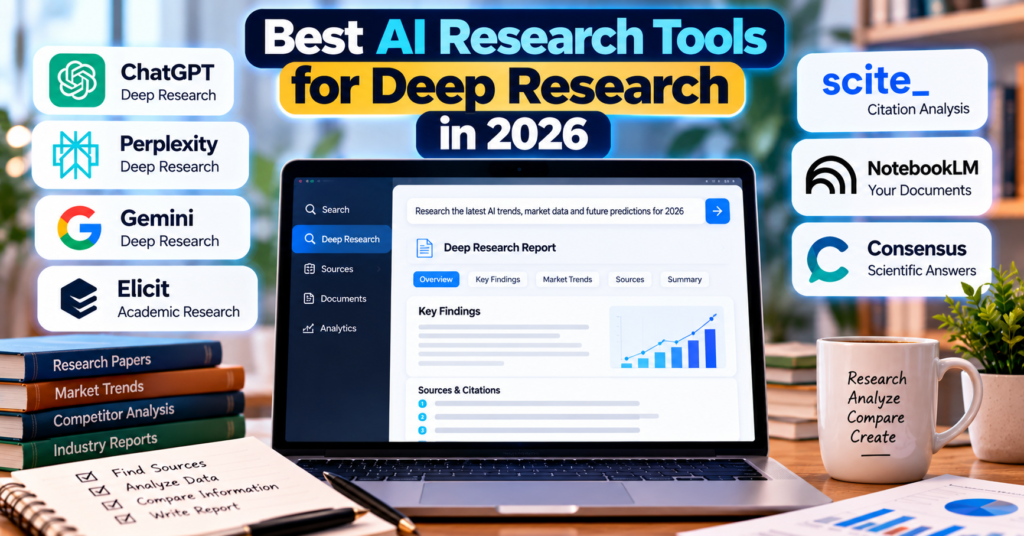
AI research tools have moved far beyond giving quick answers.
The best AI research tools in 2026 can search hundreds of sources, compare conflicting information, analyze academic papers, work with uploaded documents, and create detailed research reports with citations.
This is especially useful for students, marketers, journalists, researchers, business owners, and anyone who regularly spends hours searching Google.
However, not every AI research tool works the same way.
Some are designed for researching the open web. Others specialize in scientific papers, while certain tools are much better when you already have documents and sources that need to be analyzed.
Here are the best options for deep research in 2026.
Table of Contents
Best AI Research Tools in 2026
| AI Research Tool | Best For | Key Strength |
|---|---|---|
| ChatGPT Deep Research | Overall deep research | Multi-source research reports |
| Perplexity Deep Research | Web research | Fast source discovery |
| Gemini Deep Research | Google ecosystem | Web + Google sources |
| Elicit | Academic research | Scientific literature |
| Scite | Verifying research | Citation analysis |
| NotebookLM | Researching your sources | Source-grounded analysis |
| Consensus | Scientific questions | Academic evidence |
1. ChatGPT Deep Research
ChatGPT Deep Research is one of the strongest general-purpose AI research options available in 2026.
Instead of performing one search and generating an answer, Deep Research can investigate a complicated question across many sources before producing a structured report.
You provide the research objective, context, preferred sources, and desired output.
ChatGPT can then create a research plan that you can review or modify before the deeper investigation begins.
According to OpenAI, Deep Research is intended for complex questions that require comparing evidence and synthesizing information across multiple sources. Completed research also includes citations or source links that can be checked individually.
Best for:
- Competitive research
- Industry reports
- Product comparisons
- Market research
- Technical research
- Long-form content research
- Business decision-making
The ability to control sources is particularly useful when you do not want an AI system pulling information indiscriminately from the entire web.
DigitalDiscite internal link: If you’re interested in how AI is changing web research itself, also read our Best AI Browsers in 2026: Comet vs Chrome vs Edge vs Dia comparison.
2. Perplexity Deep Research
Perplexity Deep Research combines an AI answer engine with autonomous research.
When Deep Research is selected, Perplexity says the system can perform dozens of searches, examine hundreds of sources, reason over the collected information, and turn the findings into a research report.
This makes it particularly useful when your research begins with the public web.
Instead of opening dozens of Google results yourself, you can give Perplexity a broader research question.
For example:
“Research the growth of AI browsers in the United States and identify the major products, companies, features, and market trends.”
Perplexity can search multiple angles before combining its findings.
Best for:
- Current web research
- Competitor research
- Market trends
- Product discovery
- Technology research
- Source discovery
If you want to learn more about Perplexity’s expanding browser ecosystem, read our Perplexity Comet Browser Review 2026 on DigitalDiscite.
3. Gemini Deep Research
Gemini Deep Research is Google’s dedicated deep-research experience.
It creates a research plan, searches across sources, analyzes what it finds, and generates a detailed report.
Its biggest advantage is integration with Google’s ecosystem.
Google Search is included as a source by default, while users can also select additional supported sources such as Gmail, Google Drive, uploaded files, and NotebookLM notebooks.
That makes Gemini particularly interesting for research projects where information is divided between the public internet and your own material.
Google has also continued expanding its autonomous research technology during 2026, including newer Deep Research systems aimed at longer and more complex research workflows.
Best for:
- Google-heavy workflows
- Web research
- Research involving personal documents
- Business research
- Complex topic exploration
4. Elicit
Elicit is different from general AI search engines.
It is built primarily for scientific research and evidence-based decision-making.
Elicit can gather evidence from academic journals, scientific databases, public datasets, and uploaded internal documents.
In 2026, Elicit also introduced its Research Agent for more complex research workflows. The company has continued developing tools for systematic reviews, evidence gathering, research libraries, and collaborative research.
Best for:
- Literature reviews
- Academic assignments
- Scientific research
- Healthcare research
- Systematic reviews
- Evidence-based decision-making
If your question is mainly “What does scientific research say about this?”, Elicit can be more appropriate than a general web-search AI.
5. Scite
Scite is one of the most useful AI research tools when verification matters more than simply finding information.
Its standout feature is Smart Citations.
Instead of showing only how many times a research paper has been cited, Scite analyzes how later papers cite it.
This can help researchers see whether subsequent literature supports, contrasts with, or simply mentions a particular study.
Scite says its platform searches more than 300 million research items and provides access to a large full-text scholarly database.
Its AI Assistant can then answer questions using scientific literature as its evidence base.
Best for:
- Checking scientific claims
- Validating citations
- Finding contradictory research
- Academic writing
- Literature reviews
This solves an important problem with AI research: finding a paper does not automatically mean the paper’s conclusion has held up over time.
6. Google NotebookLM
NotebookLM research updates takes another approach to AI research.
Instead of starting primarily with the entire internet, NotebookLM is especially powerful when you already have the sources.
You can collect documents and research materials into notebooks and then use AI to understand and connect the information.
Google significantly expanded NotebookLM’s research capabilities in 2026, including more advanced reasoning and agentic capabilities for complex research projects.
This makes it useful when working with:
- PDFs
- Reports
- Research papers
- Notes
- Reference documents
- Large collections of source material
For example, a student could upload multiple research papers about one topic and use NotebookLM to identify recurring arguments, disagreements, concepts, and evidence.
Best for:
Researching a controlled collection of documents rather than searching the entire web.
7. Consensus
Consensus is another useful choice for people who want answers based on academic literature.
Instead of approaching a topic like a conventional search engine, Consensus helps users search scientific research and understand what published evidence says about a question.
It can be particularly useful for questions such as:
“Does creatine improve cognitive performance?”
or
“What does current research say about remote work productivity?”
Rather than relying primarily on ordinary websites, the goal is to surface relevant scientific evidence.
Best for:
- Students
- Researchers
- Evidence-based questions
- Scientific literature discovery
- Quick academic research
Deep Research vs Normal AI Search
There is an important difference between asking an AI a question and asking an AI to conduct research.
A normal AI search may involve:
Question → Search → Answer
Deep research is closer to:
Question → Research plan → Multiple searches → Source evaluation → Follow-up searches → Analysis → Synthesis → Citations → Final report
That difference becomes important as the complexity of the question increases.
If you only need the release date of a product, normal search is enough.
If you want to understand how that product compares with five competitors, what users think about it, how its pricing has changed, and where the market is heading, deep research becomes much more useful.
Which AI Research Tool Should You Use?
There isn’t one research tool that is ideal for every situation.
Choose ChatGPT Deep Research when you need broad, structured research across multiple sources.
Choose Perplexity Deep Research when web discovery and source-heavy research are the priority.
Choose Gemini Deep Research when you work heavily with Google Search, Drive, Gmail, or other Google sources.
Choose Elicit when your project revolves around scientific literature and systematic evidence gathering.
Choose Scite when you need to verify whether academic evidence supports or challenges a claim.
Choose NotebookLM when you already have a collection of documents that needs deeper analysis.
Choose Consensus when you want a simpler way to investigate what scientific research says about a question.
How to Get Better Results From AI Deep Research
The quality of the research still depends heavily on the question.
Instead of writing:
“Research AI video generators.”
Try:
“Compare the leading AI video generators available in 2026 for professional marketers. Evaluate video quality, audio generation, pricing, commercial-use options, major limitations, and recent product updates. Prioritize official sources and clearly cite each factual claim.”
The second prompt defines the topic, audience, comparison criteria, timeframe, preferred sources, and output requirements.
That gives the research agent much more direction.
If AI video creation is part of your research, DigitalDiscite also has a guide to the Best AI Video Generators With Audio in 2026.
Can You Trust AI Research Tools?
Not completely.
Even sophisticated research agents can misunderstand sources, miss important evidence, use outdated information, or draw conclusions that are stronger than the underlying evidence.
Citations help, but citations should not be treated as automatic proof.
For important research, check:
- Whether the cited source actually supports the claim
- When the source was published
- Whether the source is primary or secondary
- Whether newer evidence exists
- Whether multiple independent sources agree
- Whether important contradictory evidence was ignored
For academic, medical, financial, legal, or other high-stakes work, human verification remains essential.
Are AI Research Agents Replacing Google Search?
Not exactly.
Search engines are excellent when you know what you need and want to explore sources yourself.
AI research agents are useful when the job involves finding information and then organizing, comparing, analyzing, and synthesizing it.
The two approaches are increasingly blending together.
Search engines are adding AI-generated answers, while AI assistants are gaining autonomous browsing and research capabilities.
That is also why AI visibility is becoming important for website owners. If you run a brand or publication, our guide to Best GEO Tools to Track Your Brand in ChatGPT and AI Search explains how brands can monitor their presence across AI-generated answers.
Final Thoughts
The best AI research tools in 2026 are becoming closer to digital research assistants than simple chatbots.
ChatGPT Deep Research, Perplexity Deep Research, and Gemini Deep Research are strong options for broad web research.
Elicit, Scite, and Consensus are more specialized toward scientific and academic evidence.
NotebookLM is particularly useful when the research needs to stay grounded in a collection of sources you already trust.
The biggest change, however, is not any single tool.
It is the shift from AI answering questions to AI conducting multi-step research.
As research agents improve, searching, reading, comparing sources, verifying claims, and creating reports are increasingly becoming parts of one AI-powered workflow.
FAQs
What is the best AI research tool in 2026?
There is no single option for every research task. ChatGPT Deep Research, Gemini Deep Research, and Perplexity Deep Research are designed for broad multi-source research, while Elicit, Scite, and Consensus are more focused on academic and scientific evidence.
What is AI Deep Research?
AI Deep Research is a workflow where an AI system performs multiple searches, examines numerous sources, analyzes the information, and produces a detailed report rather than generating an immediate answer from a single search.
What is the best AI tool for academic research?
Elicit, Scite, and Consensus are particularly useful for academic research because they focus heavily on scientific literature. Scite is especially useful when you want to investigate how later research has cited a particular study.
Is Perplexity good for deep research?
Yes. Perplexity offers a dedicated Deep Research mode designed to perform multiple searches, analyze numerous sources, and generate a detailed research report.
Can ChatGPT conduct deep research?
Yes. ChatGPT Deep Research can create a research plan, search and analyze sources, synthesize evidence, and produce structured reports with citations or source links.
Is Google Gemini good for research?
Gemini offers a dedicated Deep Research feature and can combine Google Search with supported sources such as uploaded files, Gmail, Drive, and NotebookLM notebooks.
Can AI research tools replace human researchers?
They can automate significant parts of information discovery, summarization, comparison, and synthesis, but important research still requires human judgment. Sources and AI-generated conclusions should be checked before they are used in academic, professional, or high-stakes decisions.