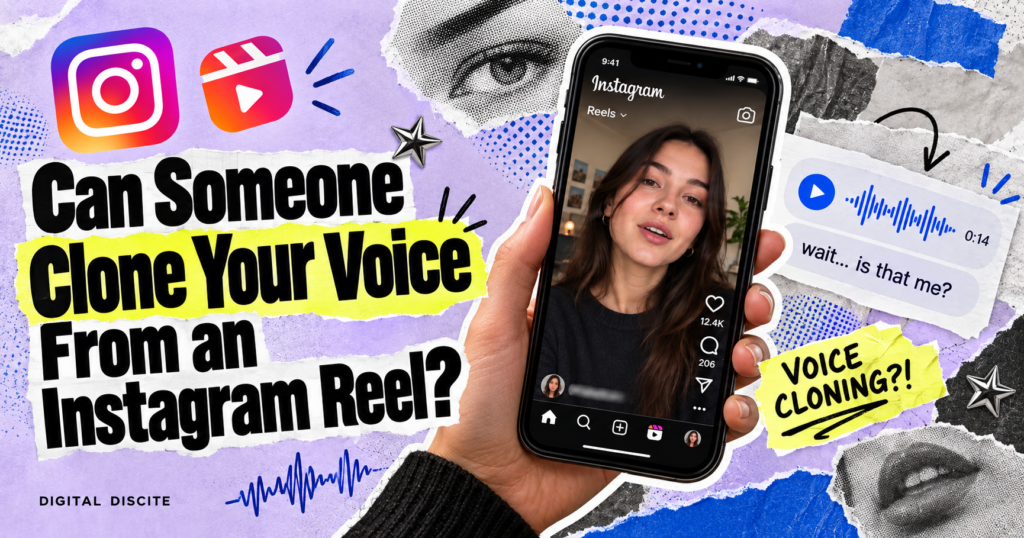
You post a Reel about your holiday, share a quick review, or record yourself telling a funny story. Your voice is clear, your profile is public, and the video feels harmless.
Could someone use that recording to make you say something you never said? Can Someone Clone Your Voice From an Instagram Reel?
Yes. An Instagram Reel containing clear speech could provide audio for an AI voice clone. That does not mean every Reel produces a convincing imitation, or that posting your voice automatically puts you in danger. It means a familiar voice should no longer be treated as proof of identity.
Here is what the technology can do, where the real risks begin, and how to protect yourself without giving up social media.
Table of Contents
Can Someone Really Clone Your Voice From an Instagram Reel?
AI voice cloning creates synthetic speech that resembles a particular person. Depending on the system, it can imitate aspects of their tone, pronunciation, rhythm, and accent.
The person does not have to record every sentence that appears in the fake audio. A system can generate new speech using the voice as a reference.
The FTC has warned that scammers can use short voice recordings taken from online content to impersonate loved ones. A Reel is therefore a plausible source of audio, although the agency’s warning is about online recordings generally, rather than a specific Instagram security flaw.
Someone does not necessarily need access to your Instagram account. If they can already hear your speech in a public video, the recording itself is the relevant exposure.
A cloned voice is an imitation of how you sound. It does not give someone your memories, passwords, or control of your account.
How Much Audio Does AI Need to Clone a Voice?
There is no universal minimum that guarantees a convincing result.
Microsoft’s VALL-E research demonstrated personalized speech generation using a three-second reference recording. However, Microsoft also explains that similarity and naturalness depend on the recording’s length, quality, background noise, and other factors. A research demonstration is not a promise that every three-second Instagram clip will work equally well.
Commercial guidance can be more demanding. ElevenLabs recommends roughly one to two minutes of good audio for instant voice cloning and emphasizes the importance of recording quality.
The sensible conclusion is that short clips can create a risk, while clearer and more suitable recordings can improve the imitation.
| Audio in a Reel | What it means for voice-cloning risk |
|---|---|
| One person speaking clearly | Provides a more useful voice reference |
| Speech covered by loud music | Makes the voice harder to isolate reliably |
| Several people talking together | Makes it harder to identify one speaker cleanly |
| Multiple clear talking videos | Creates more potential reference material |
| Music with no recording of your voice | Does not itself supply a sample of your speaking voice |
These are practical comparisons, not a test that can certify a Reel as safe. Background music, filters, and noise should not be treated as security protections.
Why a Reel Can Reveal More Than Your Voice
Voice audio is only part of the picture.
Imagine a hypothetical creator who posts a talking Reel from an airport. The caption names the destination. Other posts reveal their partner’s name, and comments identify a close relative.
An impersonator could use those public details to make a message feel believable: “I’m still at the airport. My payment isn’t working. Can you send money?”
This example illustrates a broader problem: a fake voice becomes more persuasive when the story includes real details. It does not establish how frequently criminals use Instagram Reels for this purpose.
Your posting choices matter, but so does the information surrounding the video.
What Could Someone Do With a Cloned Voice?
The FBI has documented criminals using AI-generated audio to impersonate relatives in emergencies and to impersonate known contacts when seeking financial help.
For an Instagram user, plausible misuse includes:
- A fake voice message asking a relative for urgent money.
- Audio that appears to endorse a product or investment.
- A fabricated statement intended to damage someone’s reputation.
- A message impersonating a colleague or business contact.
These are possible scenarios, not evidence that anyone who posts talking videos will be targeted.
Also, voice cloning does not automatically unlock your bank account or bypass every identity check. Different services use different safeguards. The immediate concern for many families is that someone may trust the voice enough to send money or reveal sensitive information.
How Can You Recognize an AI Voice Scam?
Some fake recordings may have odd pauses, inconsistent pronunciation, or an unusual delivery. Others may sound convincing, especially in a short, emotional message.
Treat audio glitches as clues rather than a dependable detection method.
Pay closer attention to the request:
- Is the caller demanding immediate action?
- Are they insisting that you keep the conversation secret?
- Are they asking for money through an unfamiliar payment route?
- Do they want a password, verification code, or account recovery code?
- Are they discouraging you from hanging up or contacting anyone else?
These warning signs also apply to ordinary impersonation scams. You do not need to prove that a voice is AI-generated before deciding to verify a suspicious request.
What Should You Do If a Familiar Voice Asks for Money?
1. Pause before acting
A frightening story can make verification feel like a delay you cannot afford. Take a moment before sending money or sharing information.
2. Contact the person independently
End the conversation and call a number you already know. Do not rely on a new number supplied by the caller or a link in the message.
If you cannot reach the person, try another trusted relative or contact who can check on them.
3. Use a private family phrase as an extra check
Agree on a phrase privately and keep it out of public posts and chats with strangers. Change it if it becomes exposed.
Use it alongside independent contact. A phrase is less useful if an attacker has already learned it.
4. Verify payment requests through an established channel
For work requests, follow your normal approval process. For family requests, confirm the situation before transferring money.
A useful household rule is: urgent requests still require a separate check.
How to Reduce the Risk When Posting Instagram Reels
Review who can see your videos
Meta explains that Reels follow an account’s privacy settings. A private account limits the audience, but an approved viewer could still record or share content.
For a public creator, consider which personal videos need to reach everyone and which are better shared with a smaller audience.
Share fewer details that support impersonation
Be selective about posting live travel updates, family contact information, school details, and routines.
You can still create useful, personal content while leaving out information that would help a stranger invent an emergency involving you.
Discuss voice scams with your family
Explain that a familiar-sounding voice can be faked. Agree on how you will verify unexpected requests before anyone faces a stressful call.
This conversation may be especially useful for relatives who assume that recognizing your voice proves it is you.
Protect the account as well as the audio
Use a unique password and enable two-factor authentication.
Account security serves a different purpose from protecting public recordings. It helps reduce the chance that an impersonator can send messages through your real profile, which could make a scam more believable.
For more on managing AI-related permissions, read our guide to the best AI browsers.
Be cautious with voice-upload services
Before uploading recordings to a voice or AI service, check its consent requirements, retention policy, deletion options, and rules about using recordings for model improvement.
If you compare products through our AI tools pricing database, review privacy terms alongside price and features.
What If Someone Has Already Used Your Voice?
Preserve the evidence before reporting the content. Save the message, account handle, URL, timestamps, screenshots, and any payment details.
Report impersonating accounts or abusive content through the relevant platform. Warn the people likely to receive fake requests, using a communication channel they already trust.
If money was sent, contact the bank or payment provider immediately and ask whether the transaction can be stopped or recovered. Report suspected fraud to the appropriate authority in your country. In the United States, reporting options include the FTC’s ReportFraud website and the FBI’s Internet Crime Complaint Center.
Avoid paying anyone who promises to erase every copy of a cloned voice.
Frequently Asked Questions
Can someone clone my voice without following me?
Potentially, yes, if they can access a public recording of you speaking. Following your account is not a technical requirement for imitating an accessible voice recording.
Can someone clone my voice from a private Reel?
A private audience reduces exposure. It does not guarantee that nobody with access can copy or share the recording.
Does adding music prevent voice cloning?
No dependable protection follows from adding music. It may affect audio quality, but it should not be treated as a security measure.
Will deleting a Reel remove an existing voice clone?
Deleting the Reel can reduce future access through your profile. It cannot reliably retrieve recordings someone already copied or remove a voice model created elsewhere.
Should I stop posting videos with my voice?
You do not need to assume every talking video will cause harm. Make deliberate choices about your audience, limit unnecessary personal details, and establish a verification habit with family and colleagues.
The Habit That Matters Most
Your next Reel might contain enough speech for someone to attempt a voice imitation. The quality of the result will vary, and a short clip is not a guarantee of a perfect clone.
The most useful response is a simple rule: when a familiar voice makes an unexpected request for money or sensitive information, verify it through another trusted channel.
Explore more practical technology guides on Digital Discite.