
Table of Contents
1. Introduction
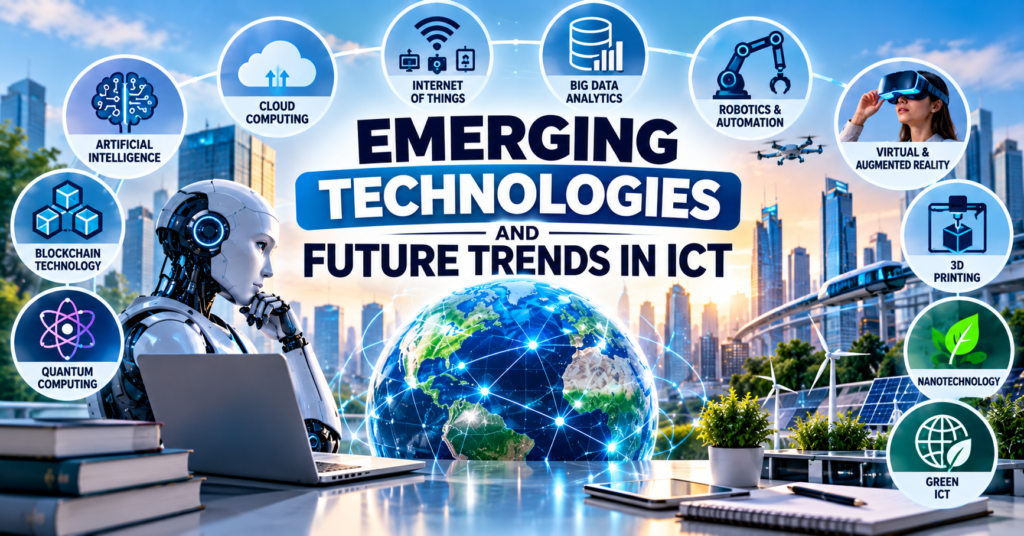
Emerging technologies are new or rapidly developing technologies that have the potential to significantly change education, science, business, healthcare, industry and everyday life.
The term future trends in ICT refers to the expected direction in which information and communication technologies will develop and be used in the coming years.
Important emerging technologies include:
- Artificial Intelligence
- Machine Learning
- Internet of Things
- Cloud Computing
- Big Data Analytics
- Robotics and Automation
- Virtual and Augmented Reality
- Blockchain Technology
- Quantum Computing
- Three-Dimensional Printing
- Biotechnology and Bioinformatics
- Nanotechnology
- Advanced Communication Networks
- Edge Computing
- Digital Twins
- Green ICT
These technologies are increasingly connected. For example, an intelligent laboratory may use sensors to collect chemical data, an Internet of Things network to transmit it, cloud storage to save it and artificial intelligence to analyse it.
2. Artificial Intelligence
2.1 Definition
Artificial Intelligence (AI) is the ability of a computer system to perform tasks that normally require human intelligence.
Such tasks may include:
- Learning from data
- Recognising images
- Understanding language
- Solving problems
- Making predictions
- Supporting decisions
- Generating text, images or computer code
AI systems may use perception, reasoning, learning, communication, planning and decision-making to achieve particular objectives. CSRC
2.2 Common Applications of AI
AI is used in:
- Virtual assistants
- Recommendation systems
- Medical diagnosis
- Fraud detection
- Language translation
- Image recognition
- Scientific research
- Self-driving systems
- Customer-support chatbots
- Weather forecasting
2.3 AI in Chemistry
AI can assist chemists in:
- Predicting the properties of compounds
- Identifying patterns in experimental data
- Discovering possible drug molecules
- Predicting chemical reactions
- Analysing spectra
- Designing new materials
- Detecting laboratory errors
- Optimising experimental conditions
For example, an AI system may examine information about thousands of compounds and predict which compound is more likely to have a desired medicinal property.
2.4 Advantages of AI
- Processes large amounts of data quickly
- Identifies patterns that may be difficult for humans to notice
- Automates repetitive work
- Improves decision-making
- Supports scientific discovery
- Reduces the time needed for some calculations
2.5 Limitations of AI
- Results depend on the quality of training data.
- AI may produce incorrect or misleading results.
- Advanced systems may be expensive.
- AI decisions may be difficult to explain.
- Personal or research data may face privacy risks.
- Human supervision remains necessary.
AI should support scientific reasoning, not replace it. A chemistry student must verify AI-generated explanations, calculations and references.
3. Machine Learning
3.1 Definition
Machine Learning (ML) is a branch of artificial intelligence in which computers learn patterns from data and use those patterns to make predictions or decisions.
Instead of giving the computer a separate instruction for every situation, developers provide data and a learning method.
3.2 Basic Types of Machine Learning
Supervised Learning
In supervised learning, the computer is trained using labelled examples.
For example, a model may be given the structures and known properties of several chemical compounds. It can then learn to predict the properties of a new compound.
Unsupervised Learning
In unsupervised learning, the computer looks for hidden patterns in unlabelled data.
For example, it may group chemical samples according to similarities in their spectral data.
Reinforcement Learning
In reinforcement learning, a system learns through rewards and penalties.
It may be used to identify the best sequence of actions for controlling an industrial process or laboratory robot.
3.3 Applications in Chemistry
Machine learning may be used for:
- Spectral interpretation
- Compound classification
- Toxicity prediction
- Reaction optimisation
- Drug discovery
- Quality control
- Environmental monitoring
- Molecular-property prediction
3.4 AI and Machine Learning
| Artificial Intelligence | Machine Learning |
|---|---|
| A broad field of intelligent computer systems | A branch of AI |
| Includes reasoning, planning and decision-making | Focuses on learning patterns from data |
| May work through rules or learned models | Mainly depends on training data |
| Includes chatbots, robots and expert systems | Includes prediction and classification models |
4. Generative Artificial Intelligence
4.1 Definition
Generative AI is a type of artificial intelligence that can produce new content based on patterns learned from existing data.
It may generate:
- Text
- Images
- Audio
- Video
- Presentations
- Computer code
- Molecular structures
4.2 Uses in Education
Students may use generative AI to:
- Obtain explanations
- Brainstorm ideas
- Create practice questions
- Summarise difficult concepts
- Improve writing
- Organise study schedules
- Understand computer code
4.3 Uses in Chemistry
Generative AI may help researchers propose:
- Possible molecular structures
- New materials
- Drug candidates
- Experimental plans
- Chemical-reaction pathways
However, generated information must be verified using textbooks, research papers and experimental evidence.
4.4 Responsible Use
Students should not:
- Submit AI-generated material as their own work.
- trust every generated answer without verification.
- enter confidential research data into unapproved systems.
- use invented references.
- allow AI to replace their own understanding.
5. Internet of Things
5.1 Definition
The Internet of Things (IoT) is a network of physical objects containing sensors, software and communication technologies that allow them to collect and exchange data.
IoT extends digital connectivity beyond traditional computers and smartphones to equipment, instruments, machines and everyday objects. NIST describes IoT systems as combinations of digital, physical, analogue and human components. NIST
Examples include:
- Smartwatches
- Smart electricity meters
- Home security cameras
- Environmental sensors
- Connected vehicles
- Smart laboratory instruments
- Industrial monitoring systems
5.2 Main Components of IoT
An IoT system normally includes:
- Sensor: Measures a physical property.
- Device: Collects and processes readings.
- Network: Transfers information.
- Software platform: Manages and analyses data.
- User interface: Displays results to users.
- Actuator: Performs an action when required.
For example, a temperature sensor may detect that a laboratory refrigerator is becoming too warm. The system can send an alert or automatically adjust the cooling system.
5.3 IoT in Chemistry
IoT can be used for:
- Continuous temperature monitoring
- Tracking laboratory chemicals
- Detecting harmful gases
- Measuring air and water pollution
- Monitoring pH and conductivity
- Controlling industrial reactions
- Recording instrument readings
- Monitoring laboratory safety
5.4 Advantages and Limitations
Advantages
- Real-time monitoring
- Automatic data collection
- Remote access to instruments
- Early detection of problems
- Better laboratory safety
Limitations
- Security and privacy risks
- Dependence on networks
- Cost of devices and maintenance
- Possibility of sensor errors
- Need for technical knowledge
6. Cloud Computing
6.1 Definition
Cloud computing is the delivery of computing services through the internet. These services may include storage, software, databases and processing power.
Cloud computing provides convenient, on-demand access to shared computing resources that can be quickly supplied when needed. NIST
6.2 Examples of Cloud Services
- Google Drive
- Microsoft OneDrive
- Dropbox
- Online office applications
- Cloud-based learning platforms
- Online scientific databases
- Remote data-analysis services
6.3 Service Models
Software as a Service
Software as a Service (SaaS) provides software through the internet.
Examples include online email, Google Docs and web-based learning systems.
Platform as a Service
Platform as a Service (PaaS) provides an online environment for developing and running applications.
Infrastructure as a Service
Infrastructure as a Service (IaaS) provides virtual servers, storage and networking resources.
6.4 Cloud Computing in Chemistry
Chemistry students and researchers can use cloud computing to:
- Store laboratory reports
- Back up research data
- Share large datasets
- Access scientific software
- Collaborate on documents
- Conduct calculations on remote computers
- Access information from different locations
6.5 Future Trend
Cloud computing will become increasingly important as scientific datasets become larger. It will also support collaboration among laboratories located in different institutions and countries.
7. Big Data and Data Analytics
7.1 Definition
Big data refers to extremely large, rapidly produced and complex collections of data that cannot easily be processed through ordinary methods.
Big data is commonly explained through the following characteristics:
- Volume: A very large quantity of data
- Velocity: Data produced and processed quickly
- Variety: Different forms of data
- Veracity: Reliability and quality of data
- Value: Useful knowledge obtained from data
7.2 Data Analytics
Data analytics is the process of examining data to discover patterns, relationships and useful conclusions.
7.3 Sources of Scientific Big Data
Scientific big data may come from:
- Laboratory instruments
- Satellites
- Sensors
- Medical records
- Chemical databases
- Genomic studies
- Environmental monitoring
- Industrial production systems
7.4 Uses in Chemistry
Big-data analytics can help with:
- Drug discovery
- Analysis of molecular databases
- Identification of pollutants
- Comparison of experimental results
- Prediction of material properties
- Quality control
- Climate and environmental research
7.5 Challenges
- Poor-quality data can produce unreliable conclusions.
- Large datasets require advanced storage systems.
- Personal or research information must be protected.
- Skilled data analysts are required.
- Data obtained from different sources may be difficult to combine.
8. Robotics and Automation
8.1 Robotics
Robotics is the field concerned with designing and operating machines that can perform physical tasks automatically or under human control.
8.2 Automation
Automation means using technology to complete a process with limited human involvement.
8.3 Laboratory Robots
Laboratory robots can:
- Handle chemical samples
- Mix solutions
- Measure liquids
- Conduct repeated experiments
- Move samples between instruments
- Record observations
- Test many compounds
- Work in hazardous environments
8.4 Advantages
- High speed
- Consistent procedures
- Reduced human exposure to dangerous chemicals
- Ability to perform repetitive work
- Improved precision
- Continuous operation
8.5 Limitations
- High installation cost
- Need for technical maintenance
- Limited ability to handle unexpected situations
- Risk of technical failure
- Possible reduction in some routine jobs
Future laboratories may combine robotics with AI. An AI system could select an experiment, while a robot performs it and records the results.
9. Virtual Reality and Augmented Reality
9.1 Virtual Reality
Virtual Reality (VR) creates a computer-generated environment that gives users a sense of being present in a different place.
Users normally interact with it through a headset and controllers.
9.2 Augmented Reality
Augmented Reality (AR) places digital information, images or animations over the user’s view of the real world.
A smartphone camera may display the name or structure of a chemical compound beside a laboratory container.
9.3 Applications in Education
VR and AR can be used to:
- Conduct virtual laboratory activities
- Demonstrate dangerous experiments safely
- Visualise atoms and molecules
- Provide interactive training
- Explore laboratory equipment
- Display three-dimensional structures
9.4 Applications in Chemistry
Students may use VR or AR to:
- Examine molecular geometry
- Understand crystal structures
- Visualise orbitals
- Practise safety procedures
- Observe reaction mechanisms
- Learn how instruments operate
9.5 Limitations
- Equipment may be expensive.
- Long use can cause discomfort or eye strain.
- A simulation may not fully reproduce real laboratory conditions.
- Technical support is required.
10. Blockchain Technology
10.1 Definition
A blockchain is a shared digital record in which transactions or information are stored in linked blocks.
Once information is properly recorded, changing it without detection is difficult.
10.2 Main Features
- Distributed record keeping
- Transparency
- Traceability
- Time-stamped records
- Protection against unauthorised changes
10.3 Applications
Blockchain may be used in:
- Financial transactions
- Supply-chain tracking
- Digital identity
- Medical records
- Educational certificates
- Pharmaceutical distribution
- Product authenticity verification
10.4 Applications in Chemistry and Pharmaceuticals
Blockchain can help track a chemical or medicine from its manufacturer to the final user. This can assist in detecting counterfeit medicines and verifying the origin of laboratory materials.
10.5 Limitations
- Some systems require considerable energy.
- Implementation may be expensive.
- Legal and regulatory issues exist.
- Incorrect information can still be entered initially.
- Not every database needs blockchain.
11. Quantum Computing
11.1 Definition
Quantum computing is an advanced form of computing based on the principles of quantum physics.
Traditional computers process information using bits that represent either 0 or 1. Quantum computers use quantum bits, or qubits, which can represent more complex states.
11.2 Importance for Chemistry
Chemical substances follow the laws of quantum mechanics. Therefore, future quantum computers may help scientists simulate complicated molecules and chemical interactions more accurately.
Possible uses include:
- Molecular simulation
- Drug development
- Catalyst design
- New-material discovery
- Energy research
- Reaction-pathway analysis
- Optimisation of chemical processes
11.3 Present Limitations
Quantum computing is still developing. Current challenges include:
- Hardware instability
- Error correction
- High operating cost
- Need for specialised conditions
- Limited availability
- Requirement for specialised knowledge
Quantum computers are not expected to replace ordinary computers completely. They are more likely to perform certain specialised calculations.
12. Three-Dimensional Printing
12.1 Definition
Three-dimensional printing, or 3D printing, creates a physical object by depositing material layer by layer according to a digital design.
It is also called additive manufacturing.
12.2 Materials Used
3D printing may use:
- Plastics
- Metals
- Ceramics
- Resins
- Composite materials
- Biological materials
12.3 Applications
3D printing is used for:
- Product prototypes
- Medical implants
- Engineering components
- Educational models
- Laboratory equipment
- Drug-delivery systems
- Tissue models
Recent scientific work shows that 3D printing is developing from a prototyping method into a platform for biochemical and environmental analysis. pubmed.ncbi.nlm.nih.gov
12.4 Uses in Chemistry
Chemists may use 3D printing to produce:
- Molecular models
- Reaction vessels
- Laboratory tools
- Microfluidic devices
- Educational models
- Customised analytical equipment
- Controlled drug-delivery systems
12.5 Advantages and Limitations
Advantages
- Customised designs
- Reduced material waste
- Rapid production
- Creation of complex shapes
- Low-cost prototypes
Limitations
- Limited material selection
- Variation in product quality
- Need for suitable digital designs
- Safety concerns with some materials
- Difficulty in large-scale production
13. Biotechnology and Bioinformatics
13.1 Biotechnology
Biotechnology involves using living organisms, cells or biological processes to develop useful products and technologies.
Applications include:
- Medicine production
- Vaccine development
- Fermentation
- Agricultural improvement
- Waste treatment
- Genetic engineering
13.2 Bioinformatics
Bioinformatics combines biology, chemistry, computer science and data analysis.
It is used to manage and analyse biological information such as:
- DNA sequences
- Protein structures
- Gene activity
- Molecular interactions
- Disease-related data
13.3 Importance for Chemistry
Bioinformatics is closely connected with biochemistry and medicinal chemistry. It may help researchers:
- Study protein structures
- Analyse interactions between drugs and biological targets
- Compare genetic sequences
- Identify possible drug molecules
- Understand biochemical pathways
14. Nanotechnology
14.1 Definition
Nanotechnology involves studying and controlling matter at the nanoscale, normally from approximately 1 to 100 nanometres.
At this very small scale, materials may show different electrical, optical, chemical and mechanical properties.
14.2 Applications
Nanotechnology is used in:
- Medicine
- Electronics
- Water purification
- Energy storage
- Sensors
- Cosmetics
- Coatings
- Environmental treatment
- Advanced materials
14.3 Importance in Chemistry
Chemists play an important role in preparing and studying nanomaterials.
Applications include:
- Nanoparticle catalysts
- Targeted drug delivery
- Chemical sensors
- Water-treatment materials
- Solar cells
- Batteries
- Protective coatings
14.4 Challenges
- Possible toxicity of nanoparticles
- Environmental effects
- Difficulties in safe disposal
- High research cost
- Need for proper regulations
15. Advanced Communication Networks
15.1 Fifth-Generation Networks
5G is a modern generation of mobile communication technology that provides high speed, low delay and support for many connected devices.
It supports:
- Smart cities
- Remote healthcare
- Connected vehicles
- IoT devices
- Industrial automation
- High-quality video communication
15.2 Future Networks
Future communication networks are expected to provide:
- Higher data speeds
- Lower communication delay
- Better coverage
- Greater energy efficiency
- Support for intelligent devices
- Improved connection between physical and digital systems
15.3 Importance for Scientific Work
Fast networks can support remote laboratories, large scientific data transfers and real-time communication between instruments and researchers.
16. Edge Computing
16.1 Definition
Edge computing processes data near the place where it is produced instead of sending all data to a distant cloud server.
For example, an intelligent chemical sensor may analyse readings locally and send only an alert when it detects a dangerous gas.
16.2 Edge Computing and Cloud Computing
| Edge Computing | Cloud Computing |
|---|---|
| Processes data near the device | Processes data on remote servers |
| Provides a faster response | Provides large storage and processing capacity |
| Can reduce network use | Usually requires internet connectivity |
| Suitable for immediate decisions | Suitable for large-scale analysis |
16.3 Applications
- Smart laboratories
- Industrial monitoring
- Self-driving vehicles
- Medical devices
- Environmental sensors
- Security systems
17. Digital Twins
17.1 Definition
A digital twin is a digital representation of a physical object, machine, system or process.
It receives data from the real system and can be used to monitor its condition or predict its behaviour.
17.2 Examples
A digital twin may represent:
- A factory
- A chemical reactor
- A laboratory instrument
- A power plant
- A human organ
- An industrial production line
17.3 Applications in Chemistry
A digital twin of a chemical plant may receive real-time data about:
- Temperature
- Pressure
- Flow rate
- Chemical concentration
- Energy use
- Equipment condition
Engineers can use the model to test possible changes without immediately disturbing the actual process.
18. Cybersecurity and Privacy Technologies
As ICT systems become more connected, cybersecurity will become increasingly important.
18.1 Cybersecurity
Cybersecurity is the protection of computers, networks, software and data from unauthorised access, damage or theft.
18.2 Major Threats
- Malware
- Ransomware
- Phishing
- Data theft
- Account hacking
- Identity theft
- Attacks on connected devices
18.3 Future Security Trends
Future security systems may use:
- AI-based threat detection
- Biometric authentication
- Advanced encryption
- Zero-trust security
- Automatic security monitoring
- Privacy-enhancing technologies
Laboratory and research data must be protected because stolen or altered scientific data can damage research and produce unsafe conclusions.
19. Green ICT and Sustainable Technology
19.1 Definition
Green ICT means designing, using and disposing of ICT equipment in ways that reduce environmental harm.
19.2 Main Practices
- Using energy-efficient computers
- Reducing electronic waste
- Recycling devices
- Extending equipment life
- Using renewable energy
- Reducing unnecessary printing
- Designing efficient data centres
- Developing low-energy software
19.3 Importance
The growth of digital technologies increases electricity use and electronic waste. Future ICT development must therefore consider environmental sustainability.
19.4 Role of Chemistry
Chemistry contributes to green ICT through the development of:
- Safer electronic materials
- Improved batteries
- Recyclable components
- Energy-efficient materials
- Environmentally friendly manufacturing processes
20. Smart Laboratories
A smart laboratory uses connected instruments, sensors, automation, software and intelligent systems to improve laboratory work.
Components of a Smart Laboratory
- IoT sensors
- Automated instruments
- Laboratory robots
- Electronic laboratory notebooks
- Cloud storage
- AI analysis systems
- Digital inventory systems
- Laboratory Information Management Systems
Benefits
Smart laboratories can:
- Record results automatically
- Reduce manual data-entry errors
- Monitor hazardous conditions
- Track chemicals and samples
- Improve reproducibility
- Provide remote access
- Generate reports
- Maintain digital records
Example
A smart chemistry laboratory may operate as follows:
Sensor collects data → IoT network transfers data → AI analyses results → Cloud system stores results → Researcher receives a report
21. Electronic Laboratory Notebooks
An Electronic Laboratory Notebook (ELN) is a digital system used to record experimental procedures, observations, calculations and results.
Benefits
- Easy searching
- Clear organisation
- Automatic dates and times
- Addition of graphs and images
- Secure backups
- Easier collaboration
- Better record of changes
Future laboratories are likely to replace many paper notebooks with secure electronic systems.
22. Mobile and Wearable Technologies
Mobile Technology
Smartphones and tablets can support:
- Online learning
- Data collection
- Communication
- Scientific calculations
- Photography of experiments
- Access to cloud files
Wearable Technology
Wearable devices are electronic devices worn on the body.
Examples include:
- Smartwatches
- Fitness trackers
- Smart glasses
- Health-monitoring sensors
- Safety-monitoring equipment
In laboratories, wearable devices may warn workers about harmful gases, high temperatures or unsafe exposure.
23. Future Trends in Education
Future education is expected to include:
- AI-supported learning
- Personalised educational content
- Virtual laboratories
- Online and hybrid classes
- Digital assessments
- Interactive simulations
- Learning through VR and AR
- Automatic feedback
- Global online collaboration
A personalised learning system adjusts content according to the student’s progress and learning needs.
Teachers will still be essential for explanation, guidance, assessment and ethical supervision.
24. Future Trends in Chemistry
The following trends are likely to become increasingly important in chemistry:
Automated Experimentation
Robots will conduct repeated experiments and record results automatically.
AI-Assisted Discovery
AI will help propose compounds, materials and experimental conditions.
Remote Laboratories
Students and researchers may control some laboratory instruments through the internet.
Digital Chemistry
Chemical information will increasingly be stored in machine-readable databases.
Computational Chemistry
Computer models will be used to study molecular structures and chemical behaviour.
Green Chemistry
ICT will help design processes that reduce waste, energy consumption and hazardous substances.
Personalised Medicine
Chemical, biological and patient data may be combined to select more suitable treatments.
Smart Materials
New materials may respond to heat, light, pressure, pH or electrical signals.
Advanced Environmental Monitoring
Connected sensors will continuously measure pollutants in air, soil and water.
25. Skills Required for the Future
BS Chemistry students should develop both chemical knowledge and digital skills.
Important future skills include:
- Basic computer literacy
- Internet research
- Data management
- Spreadsheet use
- Graph preparation
- Scientific writing
- Chemical drawing
- Statistical analysis
- Basic programming
- AI literacy
- Cybersecurity awareness
- Cloud collaboration
- Critical thinking
- Ethical use of technology
Students do not need to become computer experts immediately, but they should understand how digital tools can support chemical work.
26. Advantages of Emerging Technologies
Emerging technologies can provide:
- Faster scientific research
- Greater accuracy
- Automatic data collection
- Safer laboratory work
- Improved communication
- Better access to education
- Efficient industrial production
- Personalised healthcare
- Better environmental monitoring
- New employment opportunities
- Improved decision-making
27. Challenges of Emerging Technologies
The major challenges include:
- High cost
- Digital inequality
- Lack of trained users
- Privacy risks
- Cybersecurity threats
- Job displacement
- Dependence on machines
- Electronic waste
- Biased AI systems
- False or manipulated information
- Ethical and legal problems
- Unreliable computer-generated results
Technology should therefore be developed and used under proper human, ethical and legal supervision.
28. Ethical Issues
Important ethical questions include:
- Who owns data collected by digital systems?
- How should personal information be protected?
- Who is responsible when an AI system makes an incorrect decision?
- Can automated systems treat some groups unfairly?
- Should every scientific activity be automated?
- How should genetically modified or nanoscale materials be regulated?
- How can technology be made accessible to everyone?
Chemistry students must understand that scientific ability should be combined with responsibility.
29. Important Differences
AI and Robotics
| Artificial Intelligence | Robotics |
|---|---|
| Gives machines the ability to analyse and decide | Deals mainly with physical machines |
| May exist only as software | Usually involves hardware |
| Examples include chatbots and prediction systems | Examples include laboratory robots |
| Can control a robot | A robot may or may not use AI |
IoT and Cloud Computing
| Internet of Things | Cloud Computing |
|---|---|
| Connects physical devices and sensors | Provides computing services online |
| Collects data from the environment | Stores and processes data |
| Includes smart instruments | Includes remote servers and software |
| Often sends data to the cloud | Often receives data from IoT devices |
Virtual Reality and Augmented Reality
| Virtual Reality | Augmented Reality |
|---|---|
| Creates a completely digital environment | Adds digital content to the real world |
| Usually requires a headset | Can work through a phone or smart glasses |
| Replaces the user’s view of reality | Enhances the user’s view of reality |
30. Important Terms
Emerging technology: A new or rapidly developing technology with significant future potential.
Artificial Intelligence: Technology that enables computers to perform tasks associated with human intelligence.
Machine Learning: A branch of AI in which computers learn patterns from data.
Generative AI: AI that creates new content, such as text, images or molecular designs.
Internet of Things: A network of connected physical devices that collect and exchange data.
Cloud computing: Delivery of computing services through the internet.
Big data: Extremely large and complex collections of data.
Data analytics: Examination of data to find patterns and useful information.
Robotics: The field concerned with designing and operating machines that perform physical tasks.
Automation: Use of technology to complete tasks with limited human involvement.
Virtual Reality: A computer-generated environment experienced by a user.
Augmented Reality: Digital information placed over a view of the real world.
Blockchain: A shared digital record stored in linked blocks.
Quantum computing: Computing based on the principles of quantum physics.
3D printing: Production of physical objects layer by layer from digital designs.
Nanotechnology: Study and control of matter at the nanoscale.
Edge computing: Processing data near the device where it is generated.
Digital twin: A digital representation of a physical object or process.
Green ICT: Environmentally responsible development and use of ICT.
Smart laboratory: A laboratory that uses connected instruments, automation and intelligent systems.
31. Short Questions for Examination Preparation
- What is meant by an emerging technology?
- Define Artificial Intelligence.
- What is the difference between AI and machine learning?
- What is generative AI?
- Define the Internet of Things.
- List the main components of an IoT system.
- What is cloud computing?
- Define big data.
- What is laboratory automation?
- Differentiate between VR and AR.
- What is blockchain technology?
- Define quantum computing.
- What is 3D printing?
- What is a digital twin?
- Define edge computing.
- What is Green ICT?
- What is a smart laboratory?
- What is an electronic laboratory notebook?
- Give four applications of AI in chemistry.
- State four ethical concerns related to emerging technologies.
32. Possible Long Questions
- Explain Artificial Intelligence and its applications in chemistry.
- Discuss the Internet of Things and its role in smart laboratories.
- Explain cloud computing, its service models, advantages and limitations.
- Discuss the applications of robotics and automation in chemical laboratories.
- Explain the importance of big data and data analytics in scientific research.
- Discuss VR and AR and their applications in chemistry education.
- Explain major emerging ICT technologies and their future trends.
- Discuss the advantages, challenges and ethical issues of emerging technologies.
- Explain the future role of ICT in chemistry education, research and industry.
- Discuss the digital skills required by future chemistry graduates.
33. Summary
Emerging technologies are changing how people learn, communicate, conduct research and perform professional work. Important developments include artificial intelligence, machine learning, IoT, cloud computing, big data, robotics, VR, AR, blockchain, quantum computing, 3D printing, nanotechnology and digital twins.
In chemistry, these technologies support molecular modelling, instrumental analysis, automated experimentation, chemical-data management, drug discovery, environmental monitoring and industrial process control.
Future chemistry laboratories will become more connected, automated and data-driven. However, technology must be used with human supervision, scientific understanding, security awareness and ethical responsibility. BS Chemistry students should therefore develop ICT skills along with their knowledge of chemistry.