1. Introduction
Information and Communication Technology (ICT) refers to the technologies used to collect, process, store, retrieve and communicate information in digital form.
ICT includes:
- Computers and laptops
- Smartphones and tablets
- Computer software
- Internet services
- Communication networks
- Websites and mobile applications
- Cloud computing
- Artificial intelligence
- Digital databases
- Audio and video technologies
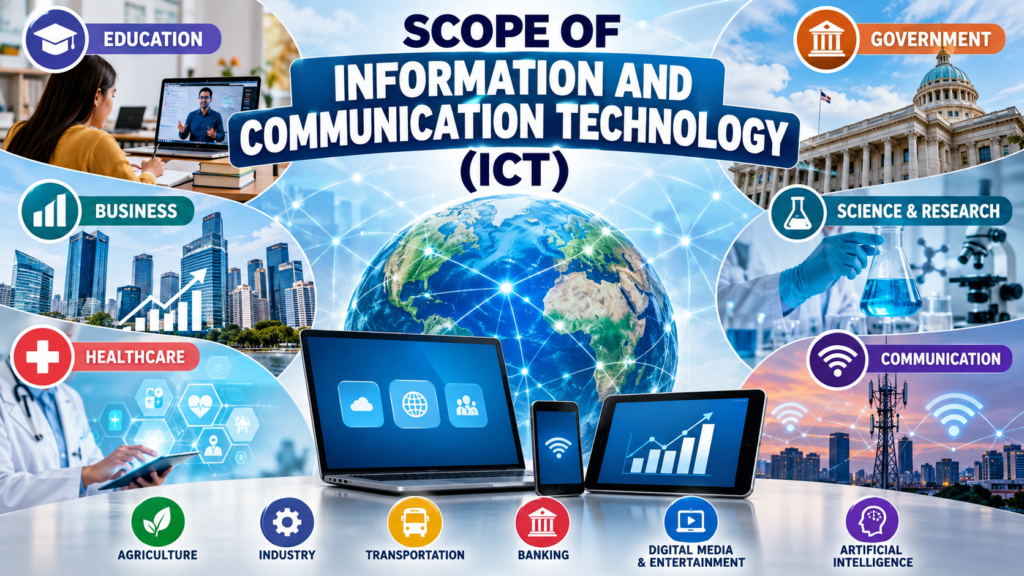
The scope of ICT means the different fields and activities in which ICT is used. ICT now plays an important role in education, business, government, healthcare, scientific research, banking, agriculture, industry, transportation, communication, digital media and entertainment.
For BS Chemistry students, ICT is especially useful for finding scientific information, recording experimental results, analysing chemical data, preparing laboratory reports and communicating research findings.
2. Importance of ICT in Modern Society
ICT has changed how people learn, work, communicate and obtain services. Information can now be shared quickly across cities and countries.
The major benefits of ICT include:
- Fast communication
- Easy access to information
- Accurate data processing
- Efficient data storage
- Automation of routine activities
- Online education and training
- Better public services
- Improved healthcare
- Support for scientific research
- Global business opportunities
- Digital entertainment
- Reduced use of paper
ICT saves time and improves the efficiency and accuracy of many activities. However, its responsible use requires digital skills, security awareness and access to suitable technology.
3. Use of ICT in Education
ICT has transformed traditional teaching and learning methods. Teachers and students can now access information, communicate and participate in learning activities through digital technologies.
3.1 Online Learning
Online learning allows students to attend classes through the internet. Lectures may be delivered live or provided as recorded videos.
Common online-learning tools include:
- Zoom
- Google Meet
- Microsoft Teams
- YouTube
- Moodle
- Google Classroom
Online learning is particularly useful for students who cannot physically attend an educational institution.
3.2 Learning Management Systems
A Learning Management System (LMS) is an online platform used to organise and manage educational activities.
Through an LMS, teachers can:
- Upload lecture notes
- Share videos and presentations
- Give assignments
- Conduct quizzes
- Record attendance
- Provide grades and feedback
- Communicate with students
Students can use it to download course material, submit assignments and check their academic performance.
3.3 Digital Educational Resources
ICT provides access to a large number of educational resources, such as:
- Electronic books
- Research articles
- Educational websites
- Online lectures
- Digital libraries
- Podcasts
- Scientific animations
- Virtual laboratories
Chemistry students can use animations to understand atomic structures, chemical bonding, reaction mechanisms and laboratory procedures.
3.4 Virtual Laboratories and Simulations
A virtual laboratory is a computer-based environment in which students can perform simulated experiments.
It allows students to:
- Practise experimental procedures
- Observe chemical reactions
- Study dangerous reactions safely
- Repeat experiments
- Understand the use of laboratory equipment
- Learn without consuming actual chemicals
Virtual laboratories cannot completely replace physical laboratories, but they provide useful preparation before practical work.
3.5 Online Assessments
Teachers can conduct tests and examinations through digital platforms. Online assessments may contain:
- Multiple-choice questions
- Short-answer questions
- Numerical problems
- Interactive activities
- Automatically graded quizzes
Online assessments provide quick results and help teachers identify areas in which students need improvement.
3.6 Communication and Collaboration
ICT enables students and teachers to communicate through:
- Discussion forums
- Messaging applications
- Video meetings
- Shared online documents
Students can work together on the same assignment through Google Docs, Google Sheets or Microsoft 365.
3.7 ICT in Chemistry Education
Chemistry students can use ICT to:
- Search for chemical information
- Access scientific journals
- Draw chemical structures
- Prepare laboratory reports
- Analyse experimental data
- Create graphs and tables
- Watch laboratory demonstrations
- Use molecular-modelling software
- Prepare presentations
- Collaborate on research projects
4. Use of ICT in Business
ICT has changed how businesses produce, advertise, sell and deliver goods and services.
4.1 Electronic Commerce
Electronic commerce, or e-commerce, means buying and selling products or services through the internet.
Online stores allow customers to:
- View products
- Compare prices
- Place orders
- Make digital payments
- Track deliveries
- Give reviews
Businesses can reach customers in different cities and countries without opening physical shops in every location.
4.2 Business Communication
Businesses use ICT to communicate with employees, customers, suppliers and investors.
Common communication tools include:
- Video conferencing
- Business websites
- Messaging applications
- Customer-support systems
- Social media
Video conferencing allows businesses to conduct meetings without requiring all participants to be present in the same location.
4.3 Digital Marketing
Digital marketing means promoting products and services through digital channels.
Major forms include:
- Social-media marketing
- Search-engine marketing
- Email marketing
- Mobile advertising
- Website advertising
- Video marketing
- Content marketing
Digital marketing allows businesses to target specific groups of customers and measure the results of advertising campaigns.
4.4 Accounting and Financial Management
Accounting software helps businesses record and manage:
- Income
- Expenses
- Sales
- Purchases
- Salaries
- Taxes
- Profits and losses
Spreadsheet software can also be used to prepare budgets, calculate financial values and create business reports.
4.5 Inventory Management
ICT helps businesses keep a digital record of their stock. Inventory systems can show:
- Available quantities
- Items that have been sold
- Products that need to be reordered
- Location of goods
- Expiry dates
- Prices of products
In pharmaceutical and chemical businesses, inventory systems can also track chemicals, medicines and laboratory materials.
4.6 Customer Relationship Management
A Customer Relationship Management (CRM) system stores and manages information about customers.
It helps businesses record customer details, purchases, complaints and communication history. This allows businesses to provide better customer service.
4.7 Remote Work
ICT enables employees to work from home or another location. Cloud storage, email, video meetings and project-management applications help employees collaborate remotely.
5. Use of ICT in Governance
The use of ICT by government departments to provide information and public services is known as electronic governance or e-governance.
5.1 Online Public Services
Citizens may use government websites and applications to:
- Apply for documents
- Pay taxes and fees
- Submit complaints
- Check application status
- Access examination results
- Apply for government jobs
- Obtain public information
- Register businesses
Online services reduce the need to visit government offices repeatedly.
5.2 Digital Record Management
Government departments maintain large amounts of information. ICT allows these records to be stored and managed electronically.
Examples include:
- Identity records
- Land records
- Tax records
- Education records
- Health records
- Employee records
- Birth and death registrations
Digital records are easier to search, update and share with authorised departments.
5.3 Communication with Citizens
Government institutions use websites, mobile applications, SMS services and social media to communicate important information.
This information may include:
- Public-health warnings
- Weather alerts
- Examination schedules
- Job announcements
- Emergency instructions
- New policies and laws
5.4 Transparency and Accountability
ICT can improve transparency by making government information available to the public. Online systems may help citizens monitor services, submit complaints and track government projects.
However, technology alone cannot ensure good governance. Proper laws, trained staff and responsible management are also required.
5.5 Electronic Voting and Registration
Some countries use digital systems for voter registration, identity verification and election-result management. Such systems must be carefully protected against errors, manipulation and unauthorised access.
5.6 Smart Cities
A smart city uses ICT to improve urban services.
Digital systems can support:
- Traffic management
- Waste collection
- Water supply
- Electricity distribution
- Public safety
- Environmental monitoring
- Emergency response
Sensors may collect information about traffic, pollution, temperature and energy consumption.
6. Use of ICT in Healthcare
ICT improves the collection, management and communication of medical information.
6.1 Electronic Health Records
An Electronic Health Record (EHR) is a digital record of a patient’s medical information.
It may contain:
- Personal details
- Medical history
- Laboratory results
- Diagnoses
- Prescribed medicines
- Allergies
- X-rays and scans
- Treatment plans
Authorised healthcare professionals can use these records to make better-informed decisions.
6.2 Telemedicine
Telemedicine is the provision of healthcare services through digital communication technologies.
Patients can consult doctors through:
- Video calls
- Telephone calls
- Healthcare applications
- Secure messaging systems
Telemedicine is useful for patients living in remote areas or those who cannot easily travel to a hospital.
6.3 Medical Imaging
ICT is used to create, store and analyse medical images, including:
- X-rays
- CT scans
- MRI scans
- Ultrasound images
These images help doctors diagnose diseases and monitor treatment.
6.4 Hospital Management Systems
Hospital-management systems are used to manage:
- Patient registration
- Doctor appointments
- Pharmacy records
- Laboratory tests
- Bed availability
- Billing
- Staff schedules
These systems improve coordination between different hospital departments.
6.5 Laboratory Information Systems
Medical laboratories use ICT to record test requests, manage samples and report results.
For example, when a blood sample is tested, the system can record:
- Patient identification
- Type of test
- Date and time
- Test result
- Name of the laboratory worker
- Reference range
6.6 Health Monitoring Devices
Digital devices can monitor:
- Heart rate
- Blood pressure
- Blood glucose
- Body temperature
- Oxygen level
- Physical activity
- Sleep patterns
Wearable devices, such as smartwatches, may collect and display health information.
6.7 ICT in Pharmaceutical and Chemical Sciences
ICT supports healthcare-related chemistry through:
- Drug research
- Molecular modelling
- Chemical databases
- Quality-control testing
- Analysis of pharmaceutical compounds
- Management of medicine inventories
- Monitoring medicine expiry dates
- Recording laboratory results
7. Use of ICT in Digital Media
Digital media refers to content created, stored and shared in digital form.
Examples include:
- Digital photographs
- Videos
- Audio recordings
- Websites
- Blogs
- Electronic newspapers
- Social-media posts
- Podcasts
- Digital advertisements
7.1 Digital Publishing
Writers and publishers can use ICT to prepare and distribute:
- E-books
- Online newspapers
- Magazines
- Research papers
- Educational notes
- Blogs
Digital publishing is faster and often less expensive than traditional printing.
7.2 Social Media
Social-media platforms allow users to create and share text, images, videos and live broadcasts.
Social media is used for:
- Communication
- Education
- News
- Marketing
- Public awareness
- Professional networking
- Entertainment
Users should verify information before sharing it because false or misleading information can spread rapidly.
7.3 Digital Journalism
Journalists use ICT to collect information, conduct interviews, edit content and publish news. Digital news can reach readers immediately.
However, speed should not replace accuracy. Journalists must verify sources and respect privacy and copyright.
7.4 Content Creation
Content creators use software for:
- Graphic design
- Photography
- Video editing
- Sound editing
- Animation
- Website development
Digital content can be shared worldwide through websites, social networks and streaming platforms.
8. Use of ICT in Entertainment
ICT has greatly expanded the entertainment industry.
8.1 Streaming Services
Streaming platforms allow users to watch videos or listen to audio through the internet without permanently downloading the complete file.
Examples include:
- Video-streaming services
- Music-streaming applications
- Educational video platforms
- Live-broadcasting services
8.2 Digital Games
Computer games can be played on:
- Computers
- Gaming consoles
- Smartphones
- Tablets
- Virtual-reality devices
Online games allow players from different locations to interact with one another.
8.3 Animation and Visual Effects
Film and television industries use computers to create:
- Three-dimensional animation
- Visual effects
- Digital backgrounds
- Computer-generated characters
- Motion graphics
8.4 Virtual and Augmented Reality
Virtual Reality (VR) creates a computer-generated environment that gives the user a feeling of being present in another place.
Augmented Reality (AR) adds digital information or images to the real-world environment.
These technologies are used in games, education, medical training, scientific visualisation and virtual tours.
8.5 Digital Music
ICT is used to record, edit, store and distribute music. Musicians can produce high-quality audio through digital recording software and share it through online platforms.
9. Use of ICT in Science and Research
ICT is essential in modern scientific work because research often involves large amounts of data.
9.1 Access to Scientific Information
Researchers use online databases and digital libraries to find:
- Journal articles
- Research papers
- Conference proceedings
- Chemical properties
- Experimental methods
- Patents
- Theses and dissertations
Examples of research platforms include Google Scholar, PubMed and ScienceDirect.
9.2 Data Collection
Digital instruments and sensors collect scientific measurements such as:
- Temperature
- Pressure
- Mass
- pH
- Absorbance
- Conductivity
- Reaction time
The collected data can be transferred directly to a computer.
9.3 Data Analysis
Scientists use spreadsheet, statistical and specialised scientific software to:
- Perform calculations
- Prepare graphs
- Compare results
- Identify patterns
- Test hypotheses
- Build scientific models
9.4 Scientific Collaboration
Researchers from different institutions and countries can collaborate through email, cloud platforms and video conferencing. They can share data, reports and research findings quickly.
9.5 Computer Simulation
Computer simulations allow scientists to study systems that may be expensive, dangerous or difficult to investigate physically.
Chemists can use simulations to study:
- Molecular structures
- Chemical bonding
- Reaction mechanisms
- Energy changes
- Behaviour of atoms and molecules
- Properties of possible new compounds
10. Use of ICT in Chemistry
ICT has a particularly wide scope in chemistry education, laboratories, research and industry.
10.1 Chemical Structure Drawing
Software such as ChemDraw can be used to draw:
- Molecular structures
- Chemical equations
- Reaction mechanisms
- Laboratory apparatus
- Structural formulas
10.2 Instrumental Analysis
Modern chemical instruments are frequently connected to computers.
Examples include:
- Spectrophotometers
- Chromatographs
- Mass spectrometers
- pH meters
- Conductivity meters
- Digital balances
Computers collect, process, display and store readings obtained from these instruments.
10.3 Laboratory Report Preparation
Students can use word-processing software to write reports and spreadsheet software to perform calculations.
ICT helps students include:
- Tables
- Graphs
- Chemical equations
- Experimental photographs
- References
- Statistical results
10.4 Chemical Databases
Chemical databases contain information about:
- Molecular formulas
- Molecular masses
- Chemical structures
- Physical properties
- Toxicity
- Chemical reactions
- Safety measures
These databases help students and researchers obtain reliable chemical information.
10.5 Laboratory Safety
ICT can provide digital safety data, chemical-hazard information and emergency procedures. Laboratory staff may use computer systems to track hazardous chemicals and their expiry dates.
11. Use of ICT in Banking and Finance
ICT has made banking services faster and more convenient.
Digital banking services include:
- Automated Teller Machines
- Mobile banking
- Internet banking
- Electronic fund transfers
- Digital wallets
- Debit and credit card payments
- Online bill payment
- Account notifications
Banks also use ICT to maintain accounts, process transactions and detect suspicious financial activities.
Advantages
- Services are available at almost any time.
- Transactions can be completed quickly.
- Customers can check their balances remotely.
- Electronic records are easy to maintain.
Risks
- Online fraud
- Identity theft
- Fake banking messages
- Weak passwords
- Unauthorised access
Users should never share passwords, PINs or verification codes with unknown persons.
12. Use of ICT in Agriculture
ICT helps farmers make better decisions and improve productivity.
Applications include:
- Weather forecasting
- Soil monitoring
- Crop-disease identification
- Market-price information
- Irrigation management
- Satellite imaging
- Agricultural education
- Online sale of agricultural products
Sensors can measure soil moisture and automatically control irrigation. Mobile applications can provide information about weather, fertilizers and pest control.
Chemistry is connected with agriculture through soil analysis, fertilizers, pesticides and water-quality testing. ICT helps record and analyse this information.
13. Use of ICT in Industry and Manufacturing
Industries use ICT to control machines, monitor production and maintain product quality.
Industrial Applications
- Computer-controlled machines
- Production planning
- Inventory management
- Quality control
- Product design
- Robotics
- Process monitoring
- Supply-chain management
- Workplace safety
Chemical industries use computer systems to monitor temperature, pressure, flow rate and chemical concentration during production.
Automation increases efficiency, but trained workers are still required to supervise systems and respond to technical problems.
14. Use of ICT in Transportation
ICT is widely used in road, railway, air and sea transportation.
Applications include:
- Online ticket booking
- GPS navigation
- Vehicle tracking
- Traffic-signal control
- Digital maps
- Electronic toll collection
- Flight scheduling
- Delivery tracking
- Traffic monitoring
- Ride-booking applications
ICT improves route planning and helps reduce travel time. Emergency services can also use location technology to reach accident sites.
15. Use of ICT in Communication
Communication is one of the most important areas of ICT.
Digital communication methods include:
- Instant messaging
- Voice calls
- Video calls
- Social media
- Discussion forums
- Websites
- Internet-based meetings
Information can be shared instantly with individuals or large groups. This has improved personal, academic and professional communication.
However, digital communication may also create problems such as misinformation, cyberbullying, spam and loss of privacy.
16. Use of ICT in Environmental Protection
ICT helps scientists and governments monitor and protect the environment.
Applications include:
- Air-quality monitoring
- Water-quality testing
- Weather observation
- Climate-data analysis
- Forest monitoring
- Wildlife tracking
- Pollution mapping
- Waste-management systems
- Disaster warnings
Chemists may use sensors and analytical instruments to measure pollutants in air, soil and water. ICT helps organise and analyse the resulting data.
17. Use of ICT in Disaster Management
ICT supports disaster preparation, response and recovery.
It can be used for:
- Weather forecasting
- Flood warnings
- Earthquake monitoring
- Emergency communication
- Digital maps
- Location tracking
- Public safety alerts
- Coordination of rescue teams
- Management of relief supplies
Timely information can save lives during floods, storms, fires and other emergencies.
18. Emerging Areas in ICT
The scope of ICT continues to expand because new technologies are constantly being developed.
18.1 Artificial Intelligence
Artificial Intelligence (AI) enables computer systems to perform tasks that normally require human intelligence.
AI can be used for:
- Language translation
- Image recognition
- Medical diagnosis
- Data analysis
- Virtual assistants
- Scientific research
- Business forecasting
In chemistry, AI may help predict molecular properties, analyse experimental results and support drug discovery.
18.2 Internet of Things
The Internet of Things (IoT) consists of physical devices connected to the internet that collect and exchange data.
Examples include:
- Smartwatches
- Smart home cameras
- Environmental sensors
- Laboratory sensors
- Health-monitoring devices
- Smart industrial machines
18.3 Cloud Computing
Cloud computing provides computing services through the internet.
It allows users to access:
- Online storage
- Software
- Databases
- Processing power
- Collaboration tools
Students can save assignments in cloud storage and access them from different devices.
18.4 Big Data
Big data refers to extremely large and complex collections of data.
Special technologies are used to analyse big data in healthcare, science, business, government and social media.
18.5 Robotics
Robots can perform repetitive, dangerous or highly precise tasks. They are used in industries, hospitals, laboratories and disaster areas.
Laboratory robots can handle samples, perform repeated measurements and support high-speed chemical analysis.
19. Advantages of ICT
The main advantages of ICT are:
- Speed: Information can be processed and communicated quickly.
- Accuracy: Computers can perform calculations with high accuracy when correct data and instructions are provided.
- Storage: Large amounts of information can be stored digitally.
- Easy access: Information can be accessed from different locations.
- Communication: People can communicate over long distances.
- Automation: Routine tasks can be completed automatically.
- Collaboration: Several users can work on the same project.
- Cost reduction: Online services can reduce travel, paper and communication costs.
- Better decision-making: Data analysis helps organisations make informed decisions.
- Support for research: ICT makes scientific information and analytical tools more accessible.
20. Limitations and Challenges of ICT
Although ICT has many benefits, it also creates certain problems.
20.1 Digital Divide
The digital divide is the difference between people who have access to ICT and those who do not.
Limited access may result from:
- Poverty
- Lack of internet services
- Lack of electricity
- Limited digital skills
- Geographical location
20.2 Privacy Problems
Websites and applications may collect personal information. If this information is misused or poorly protected, the user’s privacy may be affected.
20.3 Cybercrime
Cybercrime includes illegal activities performed through computers or networks.
Examples include:
- Hacking
- Online fraud
- Identity theft
- Data theft
- Distribution of malware
- Phishing
20.4 Misinformation
False or misleading information can spread quickly through websites and social media. Students should verify information from reliable sources.
20.5 Health Concerns
Excessive technology use may contribute to:
- Eye strain
- Poor posture
- Lack of physical activity
- Sleep problems
- Mental stress
- Technology addiction
20.6 Job Displacement
Automation can reduce the need for certain routine jobs. At the same time, it creates new employment opportunities requiring technical and digital skills.
20.7 Technical Problems
Hardware failure, software errors, weak internet connections and electricity problems can interrupt ICT-based activities.
20.8 High Initial Cost
Computers, software, networks and digital instruments may be expensive to purchase, maintain and update.
21. Ethical and Responsible Use of ICT
ICT should be used responsibly and ethically.
Students should:
- Respect the privacy of others.
- Avoid copying work without acknowledgement.
- Cite online sources correctly.
- Use strong passwords.
- Avoid suspicious links and files.
- Never spread false information.
- Respect copyright laws.
- Communicate respectfully online.
- Protect confidential laboratory and research data.
- Use artificial intelligence responsibly.
- Verify computer-generated results.
Plagiarism means presenting another person’s words or ideas as one’s own. ICT makes information easy to copy, but students must properly acknowledge all sources.
22. Important Terms
ICT: Technologies used to collect, process, store and communicate information.
Scope of ICT: The different areas and activities in which ICT is used.
E-learning: Education provided or supported through digital technology.
E-commerce: Buying and selling goods or services through the internet.
E-governance: Use of ICT by governments to provide information and public services.
Telemedicine: Provision of healthcare services through communication technology.
Digital media: Information and entertainment content stored and shared digitally.
LMS: A digital platform used to organise teaching and learning.
EHR: A digital record of a patient’s medical information.
AI: Technology that enables computers to perform tasks associated with human intelligence.
IoT: A network of physical devices that collect and exchange data through the internet.
Digital divide: The gap between people who have access to ICT and those who do not.
Cybercrime: Criminal activity involving computers or communication networks.
Virtual reality: A computer-generated environment experienced by the user.
Cloud computing: Delivery of storage, software and computing services through the internet.
23. Summary
The scope of Information and Communication Technology is broad and continues to expand. ICT is used in education, business, governance, healthcare, science, digital media, entertainment, banking, agriculture, industry, transportation and environmental protection.
In education, ICT provides online learning, digital resources and virtual laboratories. In business, it supports e-commerce, accounting, marketing and communication. Governments use it to provide public services and manage digital records. Healthcare institutions use ICT for patient records, telemedicine, medical imaging and laboratory management.
For chemistry students, ICT supports literature searching, data collection, calculations, graph preparation, chemical drawing, instrumental analysis and scientific communication. However, ICT must be used carefully because it also involves security, privacy, ethical and health-related challenges.
Therefore, knowledge of ICT is essential for BS Chemistry students because it improves their academic learning and prepares them for laboratory work, research, industry and professional employment.